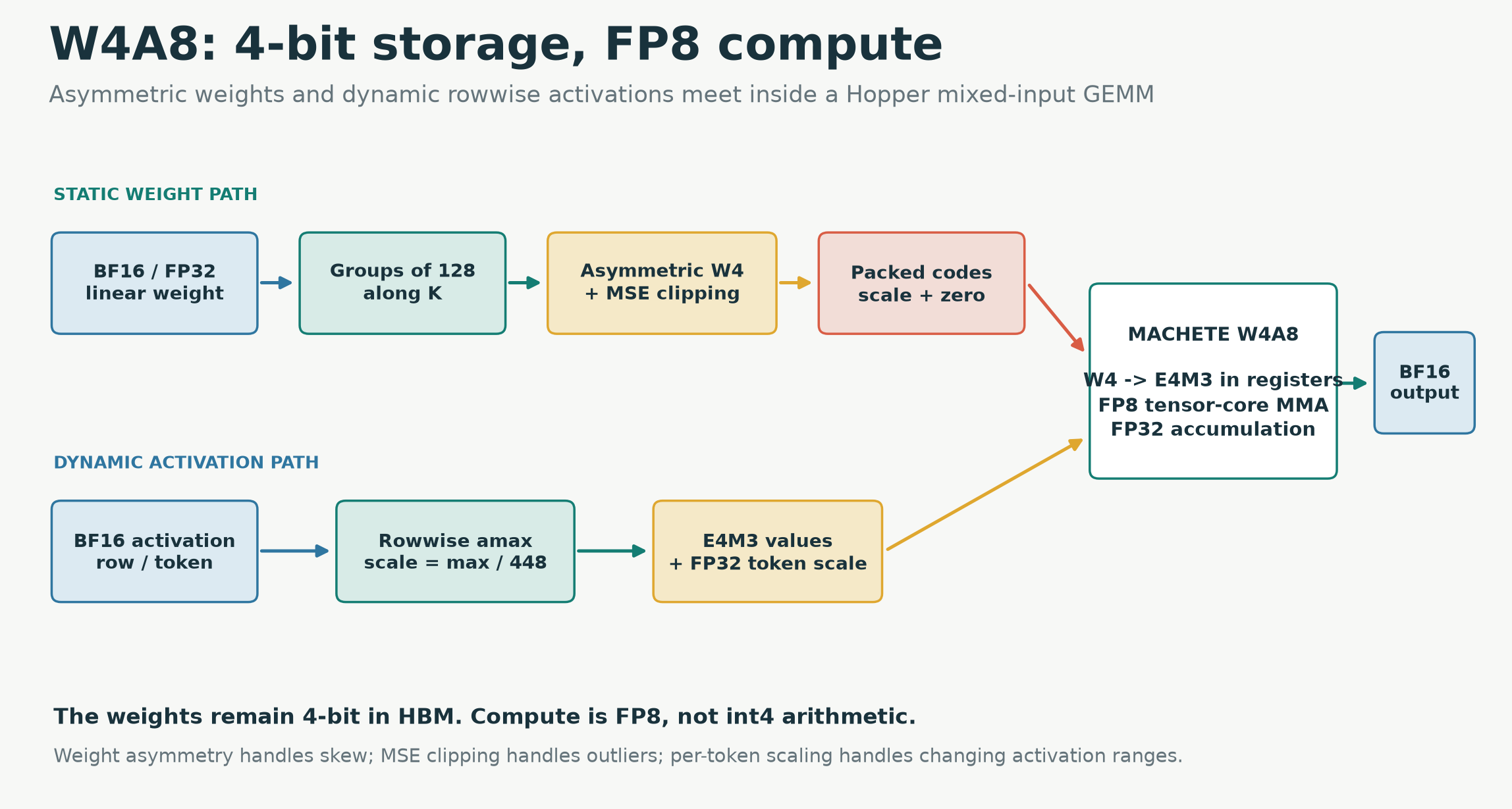
Is 4-Bit Quantization Truly Lossless?
Four bits are a storage budget, not a quality guarantee. Here is how asymmetric weights, MSE clipping, dynamic FP8 activations, and a purpose-built runtime make Tahoma’s W4A8 path both careful and fast.
Four bits are a storage budget, not a quality guarantee. Here is how asymmetric weights, MSE clipping, dynamic FP8 activations, and a purpose-built runtime make Tahoma’s W4A8 path both careful and fast.
Continuing my exploration of pair programming with AI agents, I grew pigzpp from a C++ gzip rewrite into a compression library for Python data prep, PNG, Docker layers, ZIP documents, Rust, and WebAssembly — then measured it against the tools people actually use.
A practical guide to debugging new ML setups before wasting GPU-hours: make a realistic small set memorize, measure real generation, and keep dropout on.
Background: Why BPE Training Speed Matters In practice, BPE vocabulary training is slow enough that most practitioners sub-sample their data before learning a vocabulary. A common recipe is to randomly sample a few million sentences, train BPE on that, and apply the learned vocabulary to the full dataset. For dataset with less diversity or a single language, this is usually fine — a million sentences captures most frequent patterns. But for massively multilingual models, sub-sampling is a serious compromise. In 2020, I was building a many-to-English translation system covering 500+ languages (see our ACL 2021 paper write-up). The full training corpus had roughly half a billion sentences across hundreds of languages. Many of these languages had only a few thousand sentences each. Sub-sampling a few million sentences meant that low-resource languages would be drastically underrepresented in the vocabulary — their unique character sequences and morphological patterns would be treated as rare noise rather than learned as proper subword units. ...
Modern LLMs are chat models that use Jinja2 templates to format conversations. But Jinja is Python-centric, making deployment hard in C and edge environments. Here's how to build a Jinja2 template engine from scratch in C — covering lexing, parsing, and evaluation — so you can render chat templates natively without Python.
I gave Claude Opus 4.6 and GPT 5.4 the same task: rewrite pigz (a parallel gzip tool) in modern C++23. After 70 minutes, one delivered a clean-room rewrite, the other a wrapper around the old code. Then I pushed the winner to beat pigz — and it did.
Sequence-to-sequence transduction, e.g. neural machine translation (NMT), is a general problem. This task involves transformation of a sequence of symbols to another sequence of symbols, where both input and output can have varying lengths. Challenges Sequential information: Order of input and output symbols are important. Variable length sequences with long term dependencies: Sequences can be extremely long. Symbols may contains dependencies across the sequence. E.g. Consider the text in a book, and dependencies across chapters. Unbounded vocabulary, e.g. Vocabulary in natural languages. Imbalanced distribution: Some symbols may appear frequently while other may appear rarely. E.g. The distribution of types in natural languages. ...
Many-to-English Machine Translation Tools, Data, and Pretrained Models
Macro-Average: Rare Types Are Important Too
Finding the Optimal Vocabulary for Neural Machine Translation